
Plywood vs Particle Board for Furniture: What's the Real Difference?
Homedge 03 September 2026
Short answer first: plywood wins on strength, moisture resistance and longevity; particle board wins on price and surface flatness. For load-bearing parts and humid rooms, use plywood. For budget cabinet carcasses in dry rooms, particle board with edge banding is a legitimate, cost-effective choice. Most furniture we build uses both — the skill is knowing where each belongs.
What's the Difference Between Plywood and Particle Board?
Plywood is made from thin sheets of wood veneer (called plies) stacked with the grain of each layer running perpendicular to the one below it, then glued and pressed. That cross-layered structure is what gives plywood its strength — it resists bending, warping and splitting far better than any single piece of wood of the same thickness. (Source: Wikipedia — Plywood)
Particle board (also called chipboard) is made from wood chips and sawdust mixed with resin and pressed into panels. It's cheaper to produce because it uses wood waste, and the result is a dense, perfectly flat, uniform panel — but with none of the directional strength of plywood. (Source: Wikipedia — Particle board)
At our factory we CNC-cut both materials every day, and the differences show up immediately: in the edge, in the screw hole, and in the water test.
Plywood vs Particle Board: Comparison Table
Which Is Better for Cabinets and Wardrobes?
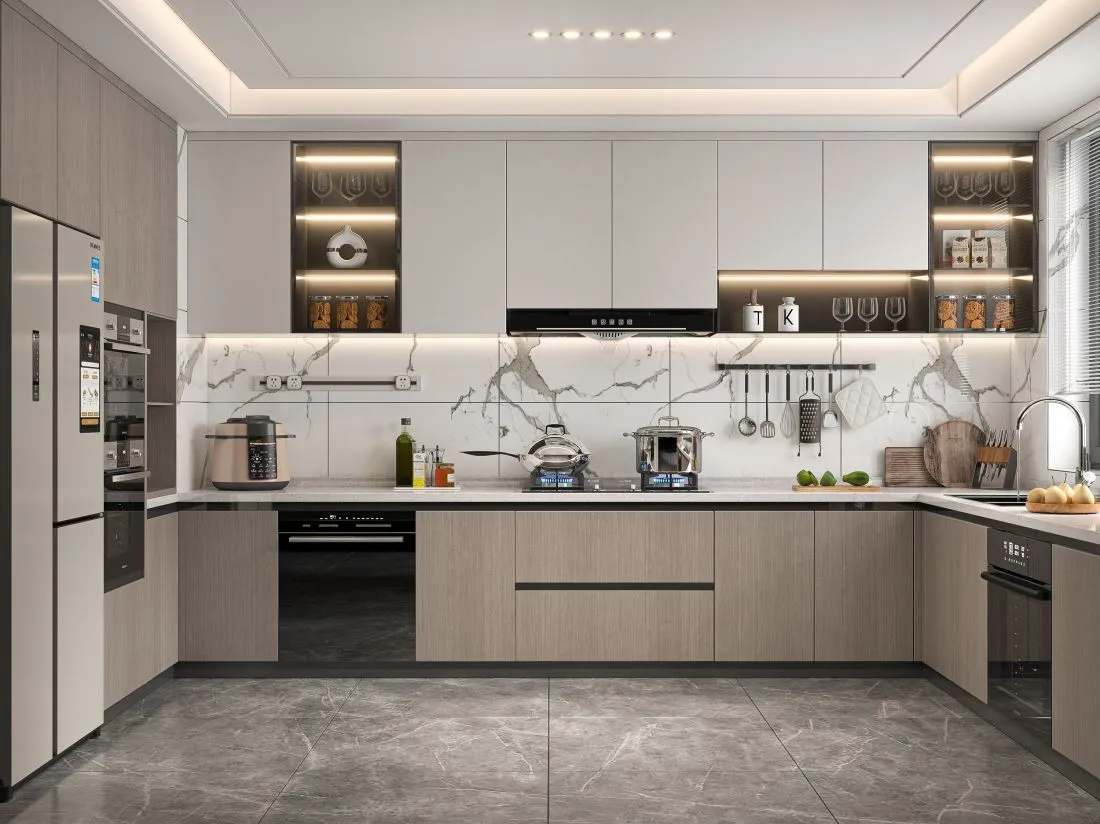
For cabinet carcasses in dry rooms (bedrooms, living rooms, offices), particle board with 0.8–1 mm PVC edge banding is the industry standard for good reason: it's flat, stable and cheap, and the edges — the only weak point — are protected by banding. Most mid-range wardrobes and kitchen cabinets use it.
For kitchens and bathrooms, where humidity and water splashes are unavoidable, we strongly prefer plywood (or moisture-resistant grades). Particle board edges absorb water, swell and crumble permanently — even with edge banding, a leaking pipe or steam will eventually find its way in.
For sliding wardrobe doors, bed frames and load-bearing shelves, plywood is the right call: it holds screws, resists sagging and won't twist over years of use.
If you're comparing all three common panels, read our guide to particle board vs MDF as well — MDF is a third option that behaves differently from both.
Which One Handles Moisture Better?
Plywood, clearly. Because each veneer layer runs crosswise, plywood resists the swelling and shrinkage that make other panels distort. Water on the surface of particle board is absorbed into the chip core; the board swells where it's wet and never returns to its original shape.
A practical test we use with clients: put a wet glass on an unsealed edge of each panel for an hour. The plywood edge shows a dark watermark; the particle board edge swells visibly. That one test decides most kitchen and bathroom material choices.
Which Is More Cost-Effective for Custom Furniture?
At factory level, an 18 mm E1 particle board panel typically costs about half to one-third of a comparable 18 mm plywood panel. That gap narrows once you add edge banding, finishing and hardware — but for large projects, the panel saving is real.
The trap is choosing particle board to save money in the wrong place. A swollen particle board shelf in a humid room costs more to replace than the plywood would have cost in the first place. Our rule: save on hidden, dry, non-load-bearing parts; invest in anything structural or moisture-exposed.
How We Choose Materials at Our Factory
Homedge Furniture has manufactured custom furniture in Chongqing, China for over 20 years — kitchens, wardrobes, living room systems, office and rental furniture. Here is the decision table we actually use on the shop floor:
We also publish material details on our plywood and particle board pages, with the grades and finishes we stock.
Frequently Asked Questions
Is plywood better than particle board? For strength, moisture resistance and longevity, yes. For cost, no. "Better" depends on where the material is used — that's why a good manufacturer uses both.
Which is stronger: plywood or particle board? Plywood. Its cross-laminated veneer structure gives it consistent strength in every direction; particle board is pressed chips and can snap or sag under concentrated load.
Is particle board good for cabinets? Yes, in dry rooms and with proper edge banding. It's the standard material for most mid-range cabinet carcasses worldwide.
Is plywood worth the extra cost? For kitchens, bathrooms, structural parts and long-life furniture, yes. For simple dry-room storage furniture, particle board is often the smarter budget choice.
Can particle board get wet? No. It absorbs water, swells permanently and never recovers. If it gets wet, replace the affected panel.
Which is better for a wardrobe: plywood or particle board? Both work. Plywood for the frame, sliding doors and base; particle board with edge banding for interior shelves in dry bedrooms.
What's the difference between particle board and chipboard? Nothing — they're two names for the same material. In some markets it's also called "low-density fiberboard", which is different from MDF.
Start Your Furniture Project
Planning custom furniture? We manufacture in plywood, particle board, MDF and solid wood under one roof in Chongqing, and we export worldwide. Tell us your project, room dimensions and budget — we'll recommend the right material for each part and send a factory-direct quote with free design consultation.
Get a Free Quote · homedge@homedgefurniture.com · WhatsApp: +86 182 2388 2903
Sources: Wikipedia — Plywood, Wikipedia — Particle board.
Share this Plywood vs Particle Board for Furniture: What's the Real Difference?


Start Your Furniture Project Today
Send your floor plan or design idea.Our team will provide professional solution.