
MDF vs Plywood: What's the Real Difference?
Homedge 10 September 2026
What's the Difference Between MDF and Plywood?
MDF (medium-density fibreboard) is made by breaking wood down into fibre, mixing it with wax and a resin binder, and pressing it into panels at high temperature and pressure. The result is a uniformly dense board with no grain, no knots and no layers — typically 600–800 kg/m³, with a modulus of rupture around 40 MPa. (Source: Wikipedia — Medium-density fibreboard)
Plywood is built from thin veneers — usually an odd number of layers — glued with the grain of each layer running perpendicular to the next. That cross-lamination is what gives plywood its strength in both directions and its resistance to warping. (Source: Wikipedia — Plywood)
At our factory we cut both every day, and the difference shows up in three places: the edge, the screw hole and the water test. MDF machines like a dream and paints like glass; plywood survives what MDF cannot.
MDF vs Plywood: Comparison Table
Which Is Stronger: MDF or Plywood?
Plywood, when the load is bending or the fixing is on an edge.
Plywood carries load across its cross-laminated layers and holds screws at the edge — the reason it is the standard choice for bed slats, sofa frames, drawer boxes and load-bearing carcasses. MDF's face is genuinely strong: screw pull-out from the face of MDF is excellent, which is why hardware and hinges mount so reliably into it. But MDF has a grain direction into the board: screw into its edge without a pilot hole and it will split like a delaminating stack, and its edges do not tolerate repeated disassembly. (Source: Wikipedia — Medium-density fibreboard)
So the honest answer is: MDF wins on the surface, plywood wins on the structure, and your hardware schedule should follow that split.
MDF vs Plywood for Cabinets and Doors
This is where the two materials stop competing and start cooperating.
MDF is the default for cabinet doors and fronts. It routes into shaker profiles, carves, molds under vacuum membrane presses and takes a flawless high-gloss paint finish — none of which a veneer-faced board can do as cleanly. That is why our MDF material page lists routed European-style doors and lacquered panels as its top applications, and why we reserve MDF for interior doors and decorative panels in dry areas.
Plywood is the default for carcasses in wet rooms. Kitchen and bathroom cabinets live with steam, splashes and leaking pipes; MDF swells there and does not recover. Our standard recommendation for bathroom vanities, balcony cabinets and kitchen cabinet carcasses is plywood — it keeps its shape and holds its fixings even when humidity is constant, as our plywood material page sets out.
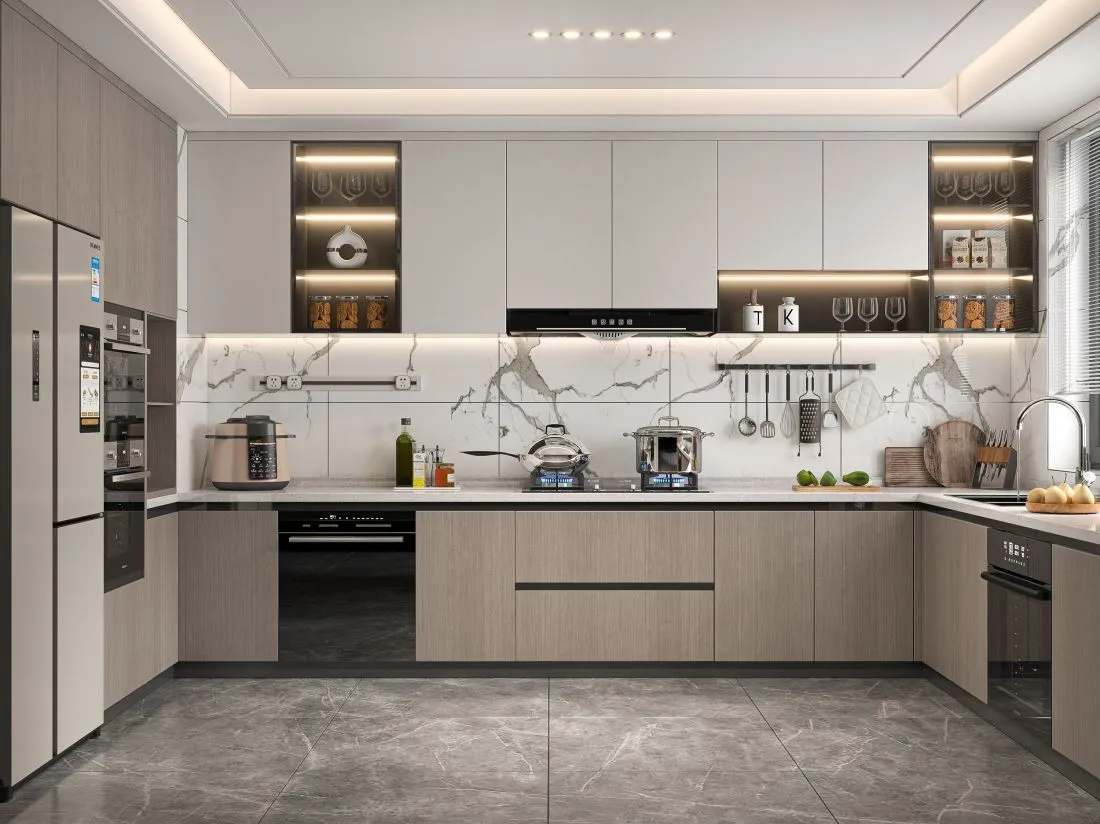
A typical premium kitchen in our production: plywood carcasses, MDF painted doors, plywood drawer boxes. That is not a compromise — it is each material doing what it does best.
Moisture, Edges and Screws
Moisture is MDF's known weakness. Low-grade MDF swells and can break down when saturated, and even sealed MDF will warp in sustained humidity. Moisture-resistant MDF (MDF.H, with the green core) handles occasional damp far better and is worth specifying for bathroom-adjacent panels — but it is moisture-resistant, not waterproof. Plywood's glued layers slow water dramatically, and marine grades are made for genuinely wet environments.
Edges are the second difference. Plywood's edge is a stack of veneers — it holds a screw and can be left visible at a push. MDF's edge is a sponge: it must be edge-banded, sealed or covered, because an exposed edge absorbs water and paint will not close a raw MDF edge convincingly. Every MDF panel we ship is edge-banded for exactly this reason.
Screws follow the edge logic: into the face of MDF, excellent; into the edge of MDF, use pilot holes and expect one assembly, not ten. Into plywood, at face or edge, reliable.
Formaldehyde and Indoor Air
MDF is bonded with resin, and lower-grade boards bonded with urea-formaldehyde can emit formaldehyde over time — the standard safety concern with MDF, and a reason to specify low-emission boards (E0/E1 class) and to seal all faces and edges, not just the visible ones. (Source: Wikipedia — Medium-density fibreboard)
In practice, for cabinetry and furniture the fix is specification, not avoidance: buy low-emission board, edge-band and coat all six faces, and choose a manufacturer who can tell you which board they used and why. If you are comparing board grades for a dry-room project, our guide to particle board vs MDF covers how the two fibre/particle boards differ.
Which Is Cheaper: MDF or Plywood?
Per sheet, MDF is usually cheaper than plywood of the same thickness — and both are typically above particle board on price. But price per sheet is not price per project. MDF's cost advantage holds while the panel becomes a painted door or a decorative panel. It evaporates the moment the design needs moisture resistance or structural edges, because you then pay again to fix the mistake. Plywood costs more up front and less over the life of the piece — the same logic behind the guidance in our durable furniture materials for rentals guide.
How We Choose Panels at Our Factory
Frequently Asked Questions
Is MDF better than plywood? Only for surfaces and shapes: MDF paints and routes better and usually costs less. For strength, moisture and edges, plywood is better. Neither wins the whole comparison.
Is plywood better than MDF? For structural and humid applications, yes. For panel doors needing a flawless painted finish, MDF is the better choice.
Is MDF stronger than plywood? MDF is denser and holds face screws very well, but plywood has higher bending strength and far stronger edges. In furniture, plywood carries the load.
Is MDF good for cabinets? For doors and fronts in dry rooms, yes — it is the standard. For carcasses in kitchens and bathrooms, no; use plywood.
Can MDF get wet? No. Standard MDF swells when saturated and does not recover. Moisture-resistant MDF (green core) tolerates damp better but is still not waterproof.
Which is cheaper, MDF or plywood? MDF is usually cheaper per sheet. Plywood costs more and typically lasts longer in humid or structural use.
What's the difference between MDF and plywood? MDF is pressed wood fibre — uniform, dense, grain-free and smooth; plywood is glued layers of veneer with alternating grain — layered, lighter, stronger and more moisture-tolerant.
Start Your Project
Planning cabinets, doors or fitted furniture? We produce in MDF, plywood, particle board, OSB and solid wood under one roof in Chongqing and export worldwide. Send us your drawings, dimensions and finish — we will recommend the right panel for each part and return a factory-direct quote with free design consultation.
Get a Free Quote · homedge@homedgefurniture.com · WhatsApp: +86 182 2388 2903
Sources: Wikipedia — Medium-density fibreboard, Wikipedia — Plywood.
Share this MDF vs Plywood: What's the Real Difference?


Start Your Furniture Project Today
Send your floor plan or design idea.Our team will provide professional solution.