
How Long Does Custom Furniture Take?
Homedge 21 October 2026
The five clocks inside one order
Every custom order runs five clocks at the same time. Only one of them decides your delivery date.
Two things follow from this table, and buyers usually get both wrong.
First: the clocks overlap, they do not queue. Cutting starts while procurement is still finishing the second panel type. So 30 days is not 3 + 5 + 12 + 7; it is a schedule where most stages run in parallel and one or two run long.
Second: at least two of the five clocks are yours. Approvals, colour decisions and payment timing sit on your side of the table. In our experience those are the stages that move most often, and they are the ones a supplier will rarely name out loud.
Where the 30 days actually goes
Below is an illustrative breakdown for a standard panel-based order — cabinet boxes, doors, edge banding, hardware, no lacquer. It is here to show proportions, not to promise a schedule.
The pattern matters more than the exact days: production is not a straight line. It is a set of parallel tracks that finish at slightly different times, and the order ships when the last track closes.
Why finishing is the bottleneck, not the saw
Wood finishing typically represents between 5% and 30% of manufacturing cost in furniture production — a wide range, and the reason is time: coats, sanding between coats, and curing.
A lacquered surface is not one pass. It is a sealer, then sanding, then colour, then topcoats, with a drying interval between each. You cannot halve that interval by asking harder. A second coat applied before the first has cured will fail later, and it will fail at the customer's site, not in your factory.
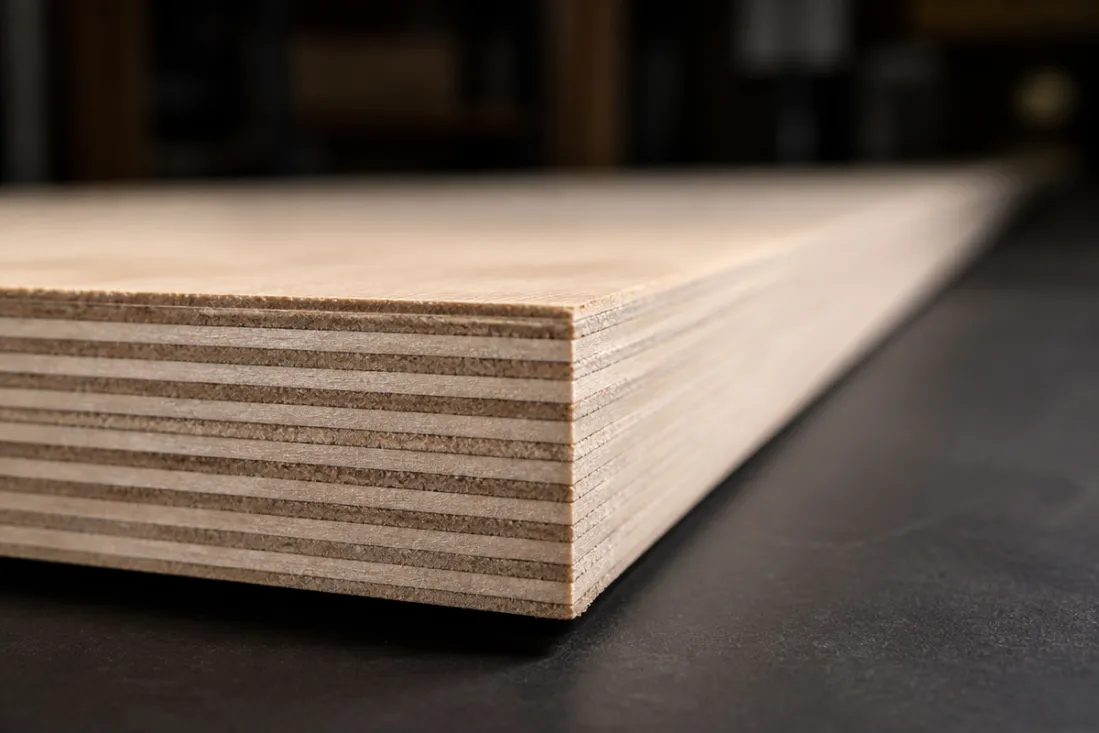
Humidity controls the interval. Wood also has to sit at a moisture content close to its end use — around 6–8% is the normal recommendation before finishing — otherwise the coating is applied onto a surface that will move underneath it.
This is why the honest answer to "can we do it in three weeks" is often "not with this finish". A melamine-faced panel has no curing queue. A hand-polished lacquer door has several.
The three things that cannot be compressed
Every factory can shorten some stages. These three are not among them, and a supplier who says otherwise is planning to hand you the problem later.
1. Panel acclimatisation. Boards cut and assembled in a different humidity from the destination will move after installation. Skipping the wait does not save time; it moves the failure into the first heating season.
2. Coating cure. Between coats and before packing. Packing a lacquered surface too early leaves marks that appear only after the container has crossed an ocean.
3. Final inspection. Once the goods are crated, nobody inspects anything. Compressing QC means the inspection happens in your warehouse, with no ability to rework.
What can be compressed: parallel production across lines, pre-booked freight, a single complete specification package at the start instead of five partial emails, and pre-approved finishes that do not need a new sample round.
Scheduling backwards from your install date
Work backwards, not forwards. Take the installation date and subtract.
Two notes on this table. Freight is not one number: sea transit varies by lane and season, and the booking itself can slip in peak months. And the sample approval is the milestone that most often breaks the plan, because it depends on a decision, not on a machine.
If you are working to a fixed opening date — a hotel, a showroom, a chain rollout — the schedule has to be built from the install date backwards before the purchase order is signed, not after production starts.
What rushing actually costs
Rushing is rarely free, and the cost usually appears somewhere other than the invoice.
Air freight instead of sea. It buys days, and it is charged by weight on furniture, which is the worst possible cargo for air.
Skipping the sample. The cheapest stage to repeat and the most expensive one to skip.
Changing the specification mid-production. Materials already cut become scrap, and the line has to be re-sequenced around your change.
Packing before the coating is fully cured. The damage shows up in the container, after the balance has been paid.
A realistic plan costs nothing. A compressed plan costs either money or quality, and usually both.
FAQ
Is 30 days from the deposit or from the approved drawings? From the approved drawings and the deposit — whichever comes later. A deposit without a signed drawing set does not start production.
Does a larger order take proportionally longer? Not proportionally. Cutting and edge banding scale with volume more slowly than people expect; finishing scales almost linearly, because it is hand work per panel.
Can the sample time be shortened? The 3–5 days of factory time is already tight. What usually stretches it is the approval loop on your side, and that is the part worth planning for.
What if I need it faster than 30 days? Tell the factory the install date first, not the desired production time. A factory can re-sequence a line; it cannot re-sequence chemistry.
Planning a project
If you are working to a fixed date, send the install date and the room schedule with your drawings. We will build the production timeline backwards from it and tell you which stages are on the critical path — before you commit to the order.
- Email: homedge@homedgefurniture.com
- WhatsApp: +86 182 2388 2903
- See how the factory is set up: our factory
- Related reading: Kitchen Cabinet Materials
Share this How Long Does Custom Furniture Take?


Start Your Furniture Project Today
Send your floor plan or design idea.Our team will provide professional solution.