
Is Solid Wood Furniture Really Better Than Plywood?
Homedge 19 October 2026
What "Solid Wood" Actually Means on a Spec Sheet
This is where most buying decisions go wrong, so it is worth being precise.
In furniture trade language, a piece described as "wood solids with cherry veneers" is usually a plywood or other engineered panel covered in a veneer. The phrase "wood solids" is a term of art, not a promise of solid planks, and it is common for manufacturers and retailers to use it exactly that way. Buyers read it as "the body is real wood"; the trade reads it as "the core is a wood-based panel". Both readings survive because the term is never defined on the invoice.
In the United States the rule is stricter: furniture may not be advertised as solid wood unless every exposed surface actually is solid wood. That rule — summarised, with its Federal Trade Commission case citations, in Wikipedia's entry on solid wood — is a useful test wherever you buy, because it forces the question onto the surfaces you can see.
So before comparing plywood and solid wood, ask three questions about the piece in front of you:
- Which surfaces are exposed? Tops, doors, side panels, edges that catch the light. These are what a customer judges, and where solid wood or a good veneer is worth paying for.
- Which parts are structural? Carcass panels, shelves, drawer bottoms, bed slats. These are hidden, and this is where plywood does its best work.
-
What does the invoice actually say? "Solid wood frame, plywood panels, oak veneer" is an honest and buildable specification. "All solid wood" with a low price is almost never one.
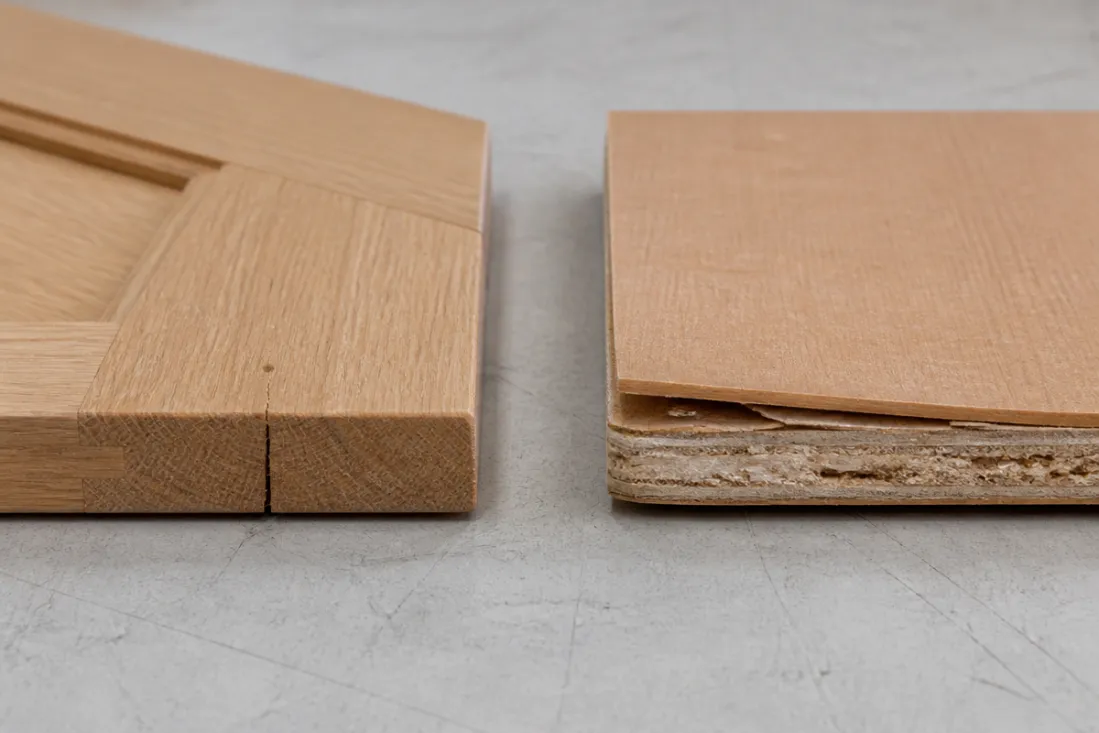
Where Plywood Wins
Plywood is made from thin layers of veneer glued with the grain of each layer turned perpendicular to the one below. That cross-lamination is the whole point: it reduces swelling and shrinkage in thickness, keeps the panel flat, and makes strength consistent in both directions. An odd number of plies keeps the sheet balanced, which is why good plywood stays flat instead of cupping.
In practice, that gives plywood four jobs in furniture:
- Carcasses and vertical panels. A cabinet side is a big flat panel that must stay flat. Plywood's cross-layered structure holds it straight in a way a solid board of the same thickness does not.
- Shelves and spans. Bending stress is highest at the face layers and near zero in the middle, so a thicker plywood panel spans further under the same load. Long bookshelves and wardrobe shelves are plywood territory.
- Drawer boxes and anything that gets knocked. Plywood holds screws at the edge far better than a solid board cut across the grain, and it tolerates being disassembled and reassembled.
- Wet and humid zones. Sink cabinets, vanity units, balcony cabinets, dishwasher surrounds. But this depends entirely on the glue: interior plywood is normally bonded with urea-formaldehyde adhesive, which has limited water resistance, while exterior and marine grades use phenol- or resorcinol-formaldehyde adhesive specifically to prevent delamination. "Plywood" alone tells you nothing about moisture performance — the adhesive class does.
That last point is the one worth putting in writing. Ask for the glue class, not just the material name.
Where Solid Wood Earns Its Price
Solid wood is the same material all the way through, and that single property drives everything it is good at.
- Repairability. A dent or a scratch in solid wood can be sanded out and refinished. A veneer that lifts or chips is difficult and sometimes impossible to repair. For a hotel, a restaurant or a piece a client expects to keep for twenty years, this is a real operational advantage, not a romantic one.
- Exposed structure. Legs, arms, bed posts, door frames, edge profiles and handles take impact and show wear. Solid wood can be re-shaped and re-sanded; a veneered edge cannot.
- Doors that get touched. A door rail or stile in solid wood takes hardware, handles and daily hand contact without the wear showing at the edge.
- Perceived value. A client who runs a hand along a solid oak rail knows what they are feeling. That is a legitimate reason to spend money — as long as it is spent on the parts that are actually touched.
What solid wood is not good at is being a large, flat, unrestrained panel. Wood expands and contracts across the grain as moisture content changes, and a wide solid panel can move by half an inch (about 12 mm) in width across a season. That movement is normal physics, not a defect — but it has to be designed for.
The Failure Modes, and Why Climate Decides Them
Both materials fail predictably, and in both cases the cause is moisture rather than load.
Solid wood fails by moving. Uneven shrinkage is what produces warping — bow, crook, cup and twist — and the contributing factors are species, grain orientation, airflow, sunlight, uneven finishing and temperature. A wide solid slab door in a heated, air-conditioned room dries on the inside face faster than the finished outside face, and the panel cups. A frame-and-panel door solves this by design: the panel floats inside the frame with clearance at the groove (typically around 6 mm, a quarter inch) so it can move without distorting the door. This is why traditional joinery — and most good cabinet doors — use a frame with a floating panel rather than one wide board.
Plywood fails at the edge. Cross-lamination protects the faces, not the exposed core. An unsealed or poorly banded edge is where moisture enters, and once the plies take up water the panel swells and the edge lifts. The second plywood failure is delamination from the wrong adhesive for the environment: interior glue in a bathroom is a specification error, not a manufacturing one.
Two practical consequences for buyers:
- Dry, heated interiors (North America, Northern Europe, the Gulf in summer) punish wide solid panels and reward frame-and-panel construction or veneered panels.
- Humid, coastal and tropical markets punish unsealed edges and interior-grade glue far more than they punish solid wood.
Neither climate argues for one material everywhere. Both argue for sealing every edge and specifying the adhesive for the room.
The Build We Actually Make
This is the split we use on contract work, and it is not a compromise — it is the standard way to get both durability and a price that survives a tender:
If a project needs one sentence to describe it, this is it: plywood where it is hidden and must stay flat; solid wood where it is seen and will be touched.
What to Write in Your Order
Six lines that remove almost all of the ambiguity:
- By part, not by piece. "Carcass: 18 mm plywood, exterior glue, all edges banded" — not "solid wood construction".
- Adhesive class for any panel in a wet room. Interior, exterior or marine grade, stated explicitly.
- Edge treatment on every panel that will be visible or near moisture. Banding material, thickness, and whether edges are sealed after cutting.
- Which surfaces are solid wood. Name them. If the answer is "frames and legs only", write that, and let the price reflect it honestly.
- Movement allowance for any solid panel wider than a door rail — frame-and-panel construction, or a specified expansion gap.
- Sample approval on a full door or drawer front, in the finish, not a material chip. Movement, colour match and edge quality only show up at full size.
For buyers comparing quotes, the useful comparison is not price per cubic metre of board — it is price per finished part, with the material and glue class of each part listed. Two quotes that both say "solid wood" can describe furniture that shares almost nothing.
Frequently Asked Questions
Is solid wood furniture better than plywood? Not as a general rule. Solid wood is better where the material is exposed, touched or needs to be repaired; plywood is better where a panel must stay flat, span a distance, hold a screw at the edge or sit in a humid room. Most well-built furniture uses both.
Is plywood furniture cheap furniture? Plywood is a more expensive panel than particle board, and it is the normal choice for mid- and high-end case goods and for contract furniture. Price depends on the panel grade, the veneer, the edge banding and the hardware — not on the word plywood.
Can plywood be described as solid wood? No, and the distinction matters commercially. In the United States, furniture may not be advertised as solid wood unless all exposed surfaces are solid wood. A "wood solids with veneers" description usually means a plywood or engineered core.
Does solid wood last longer than plywood? It can last longer because it can be sanded and refinished, which plywood-faced panels cannot. But a well-sealed plywood carcass will outlast a badly built solid wood one, because the failure mode of solid wood — movement and cracking — is a design issue, not an age issue.
Which is better for a humid climate? Neither material alone is the answer: the adhesive and the edge sealing are. Exterior-grade plywood with every edge sealed performs better in a bathroom than interior-grade plywood; a frame-and-panel solid door performs better in a heated dry room than a wide solid slab.
Why do some solid wood doors crack in winter? Because the panel is restrained while it shrinks. Heating lowers indoor humidity, the wood loses moisture and contracts across the grain; if the panel is glued or pinned rigidly into a frame, the stress has nowhere to go. A floating panel with clearance absorbs that movement.
Start Your Furniture Project
We manufacture custom bedroom, kitchen and whole-home furniture in Chongqing, China — panel cutting, edge banding, veneering, solid wood frames and hardware fitting under one roof, with 20+ years of export experience. Send your drawings or a reference photo, tell us which surfaces must read as solid wood, and our team will specify the build part by part and quote it from the factory.
If you want the material background first, start with our pages on plywood and solid wood, or read MDF vs plywood and how cabinet materials are chosen for kitchens.
Get a Free Quote · homedge@homedgefurniture.com · WhatsApp: +86 182 2388 2903
Sources: Wikipedia — Plywood, Wikipedia — Solid wood, Wikipedia — Frame and panel, Wikipedia — Wood warping, Wikipedia — Wood drying.
Share this Is Solid Wood Furniture Really Better Than Plywood?


Start Your Furniture Project Today
Send your floor plan or design idea.Our team will provide professional solution.